



Every Rep's Deck Looked Like a Different Company
A sales team lives in slides. Every pitch, every follow-up, every quarterly review is a deck, and most of them get built fast, by different people, the night before. Without a system they drift, and the brand fractures at the worst possible moment: in front of a prospect deciding whether to trust you.
An inconsistent deck does quiet damage. Mismatched colors, three different fonts, a chart that looks nothing like the last one. None of it is fatal on its own, but together it reads as disorganized, and a buyer reads disorganized as risky.
The job was to make the on-brand version the easy version, so a rep in a hurry still produces something that looks like it came from one confident company. Then to prove the system with a sales deck good enough to win the room.
- A ready layout for every pitch moment, so no one starts from blank
- Consistency that survives being built fast by non-designers
- Data and results framed to persuade, not just to fill a slide
- A look polished enough to hold up across the table from a buyer
- Rules clear enough to follow under deadline pressure
- Every rep rebuilds the same slides a slightly different way
- Colors, fonts, and charts diverge from deck to deck
- The pitch reads as disorganized, which a buyer reads as risk
- Strong results get buried in weak, text-heavy slides
- The brand looks least like itself at the point of sale
A brand is never more exposed than in a sales deck. This project treated that moment as a design problem worth solving once, for everyone.
Four Rules for a System a Sales Team Won't Break
A sales system only works if it holds up at speed, in the hands of people whose job is closing, not designing. Four principles kept it usable and hard to break.
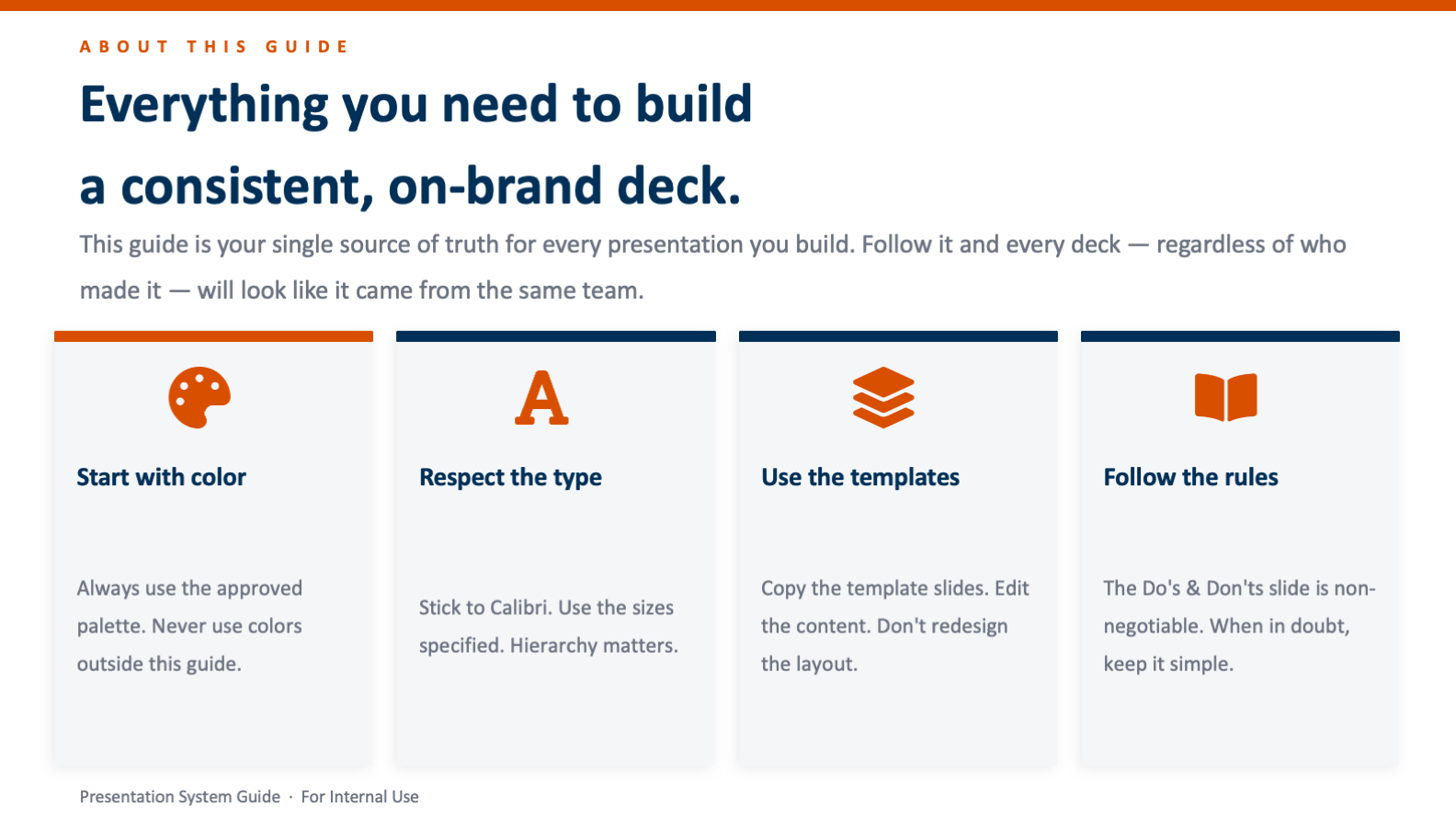
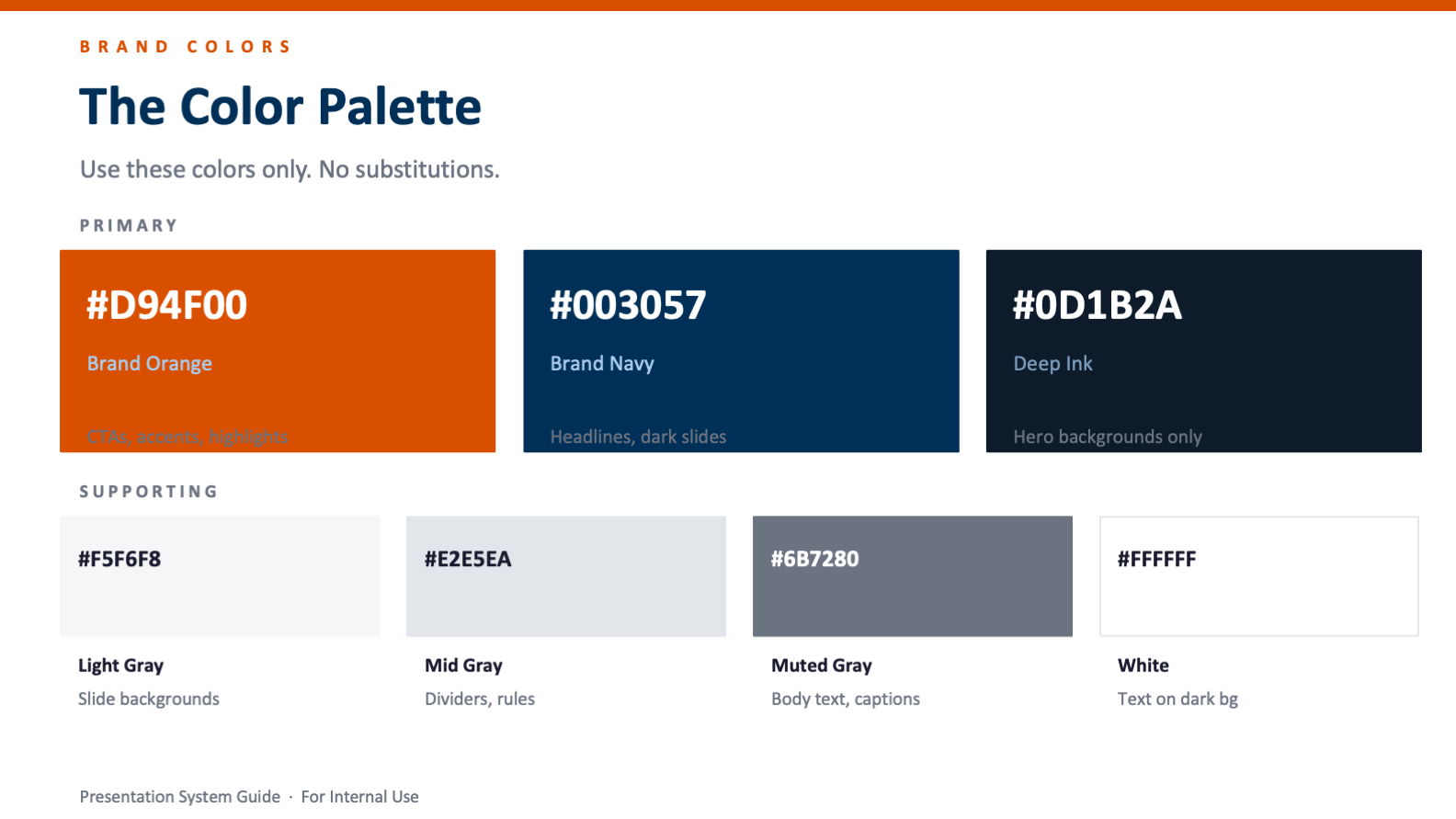
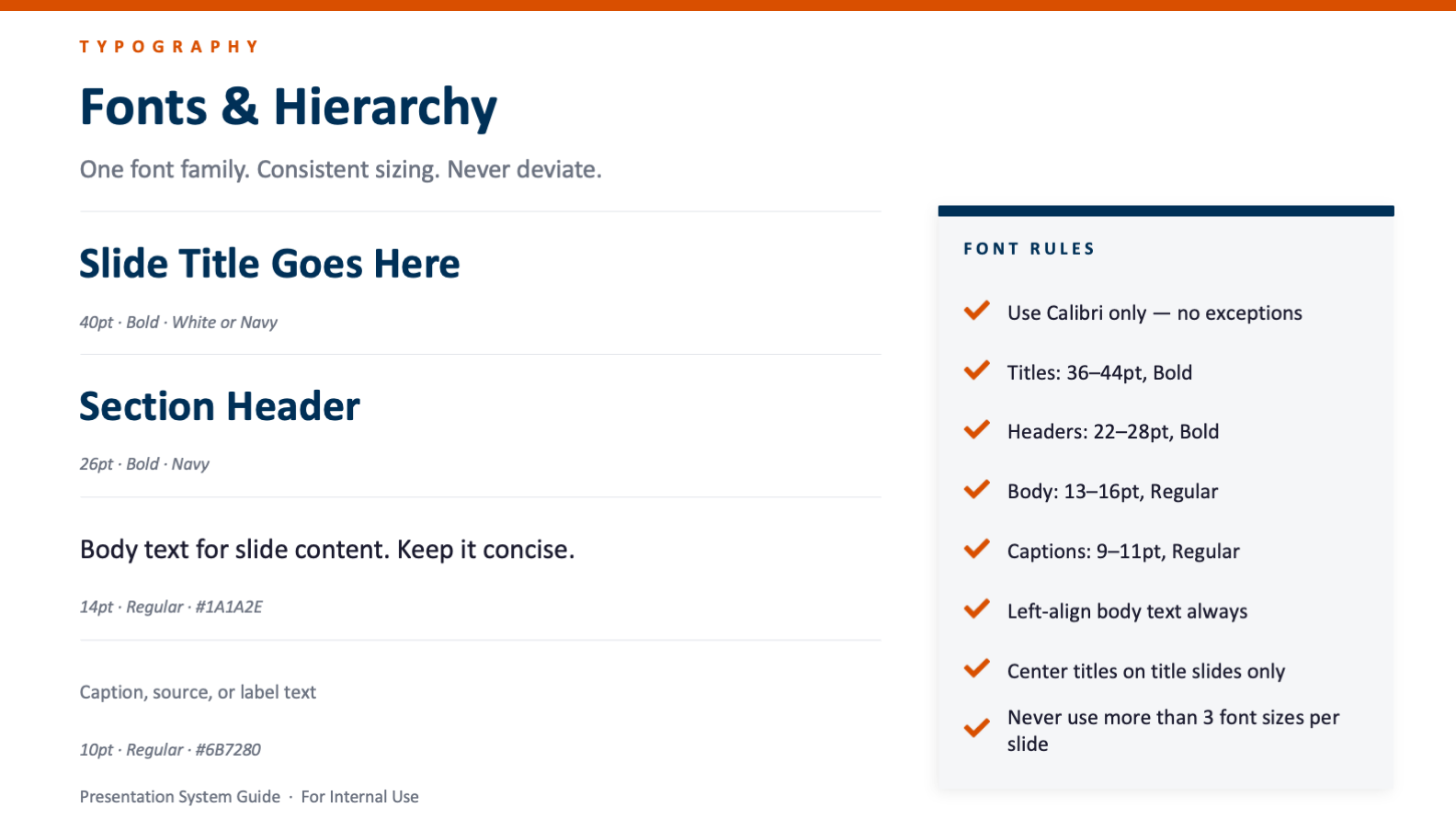
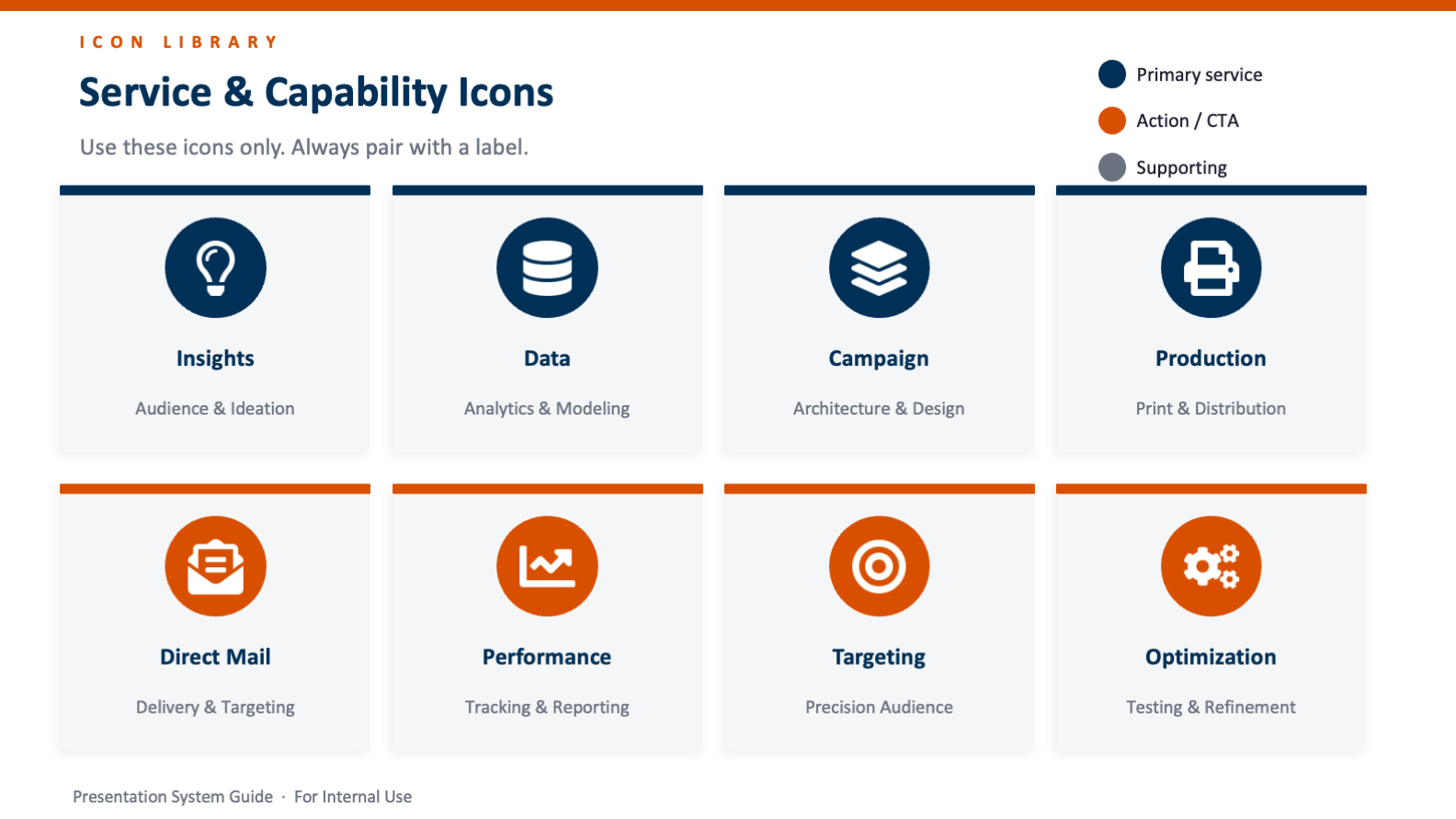
Color, type, icons, and rules live in a single system guide, the one place a rep checks before building. When the answer to "is this on-brand" is always in the same document, consistency stops being a matter of memory or taste.
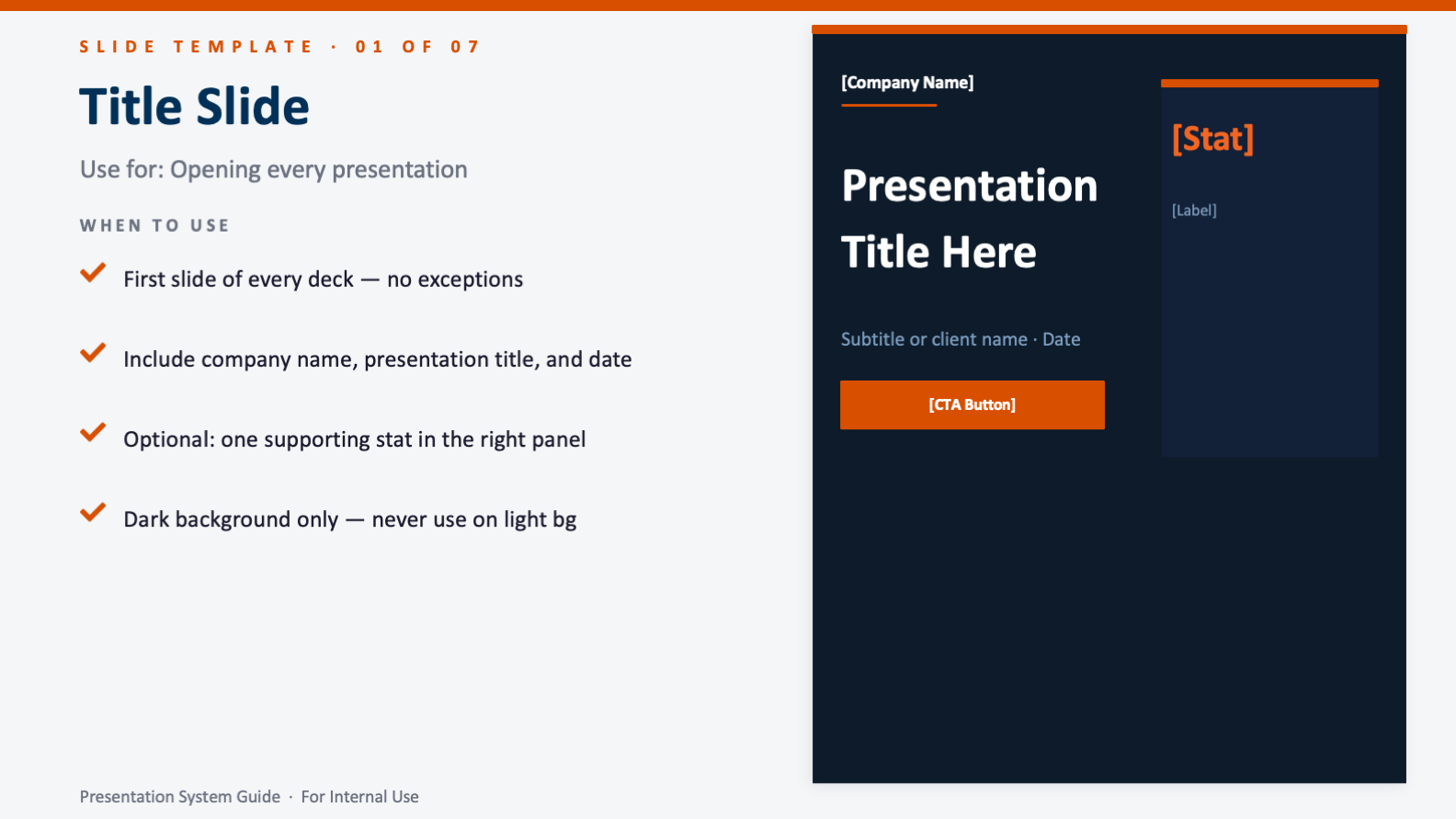
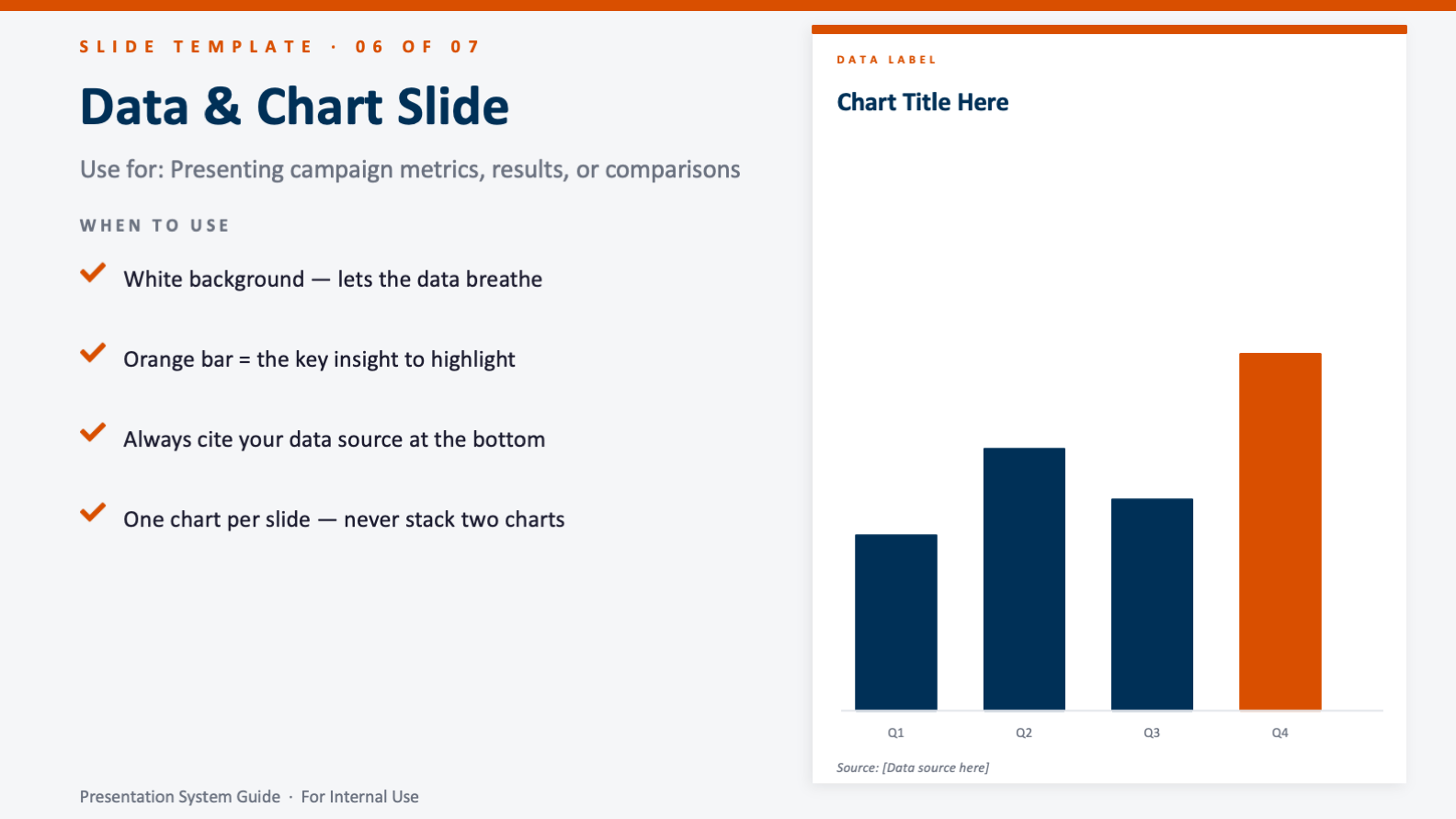
Title, agenda, section divider, two-column, stats, and data each get a finished layout with a when-to-use note. Because every pitch moment already has a slide, no one has to improvise one and break the system doing it.
Numbers are the most convincing thing in a sales deck, so the system gives them room. Big, scannable figures and clean charts are built in, so the strongest evidence leads rather than hides inside a paragraph.
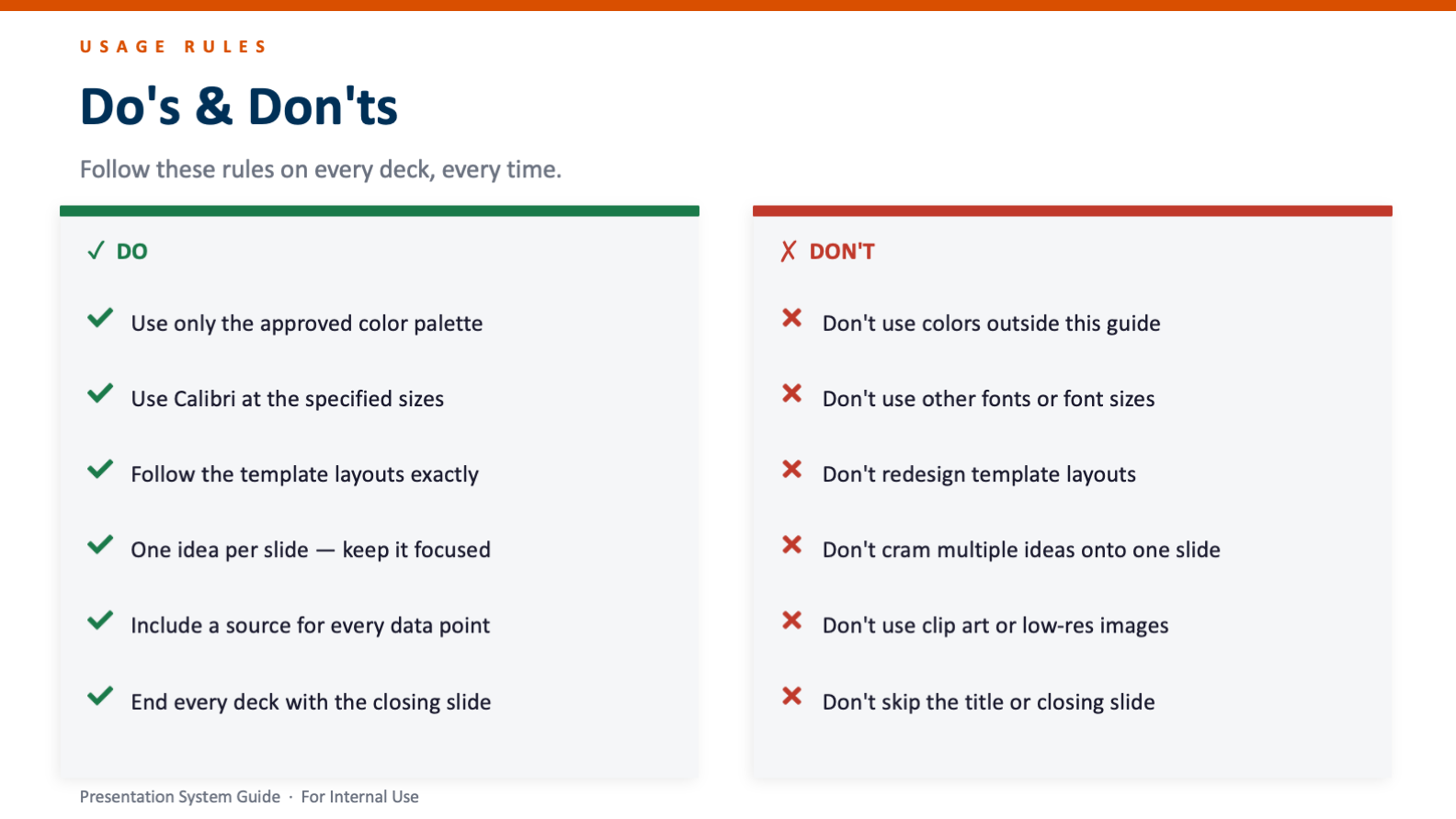
A plain do's and don'ts keeps the system intact when a deck is being built fast the night before a pitch. The guardrails are simple enough to follow without thinking, which is exactly when they matter most.
The System, and the Deck It Builds
The project has two halves. A system guide that sets the standard, and a sales deck that puts it to work. The first makes consistency effortless. The second shows what that consistency buys you in front of a client.
One source of truth
The system guide turns "make it look good" into something anyone can follow. Four simple rules, start with color, respect the type, use the templates, follow the rules, govern every deck, so the output looks like one team made it no matter who actually did.
A template for every moment
Seven reusable layouts cover the whole arc of a pitch, from title and agenda to section dividers, two-column comparisons, stat callouts, and data charts. Each one pairs a finished slide with a clear when-to-use guide, so a rep knows exactly which to reach for.
The pitch, built from the system
The sales deck is the system in action. Every slide is drawn from the library, so a persuasive, on-brand pitch comes together by assembly rather than from scratch. This is the proof that the standard holds where it counts, in front of a client.


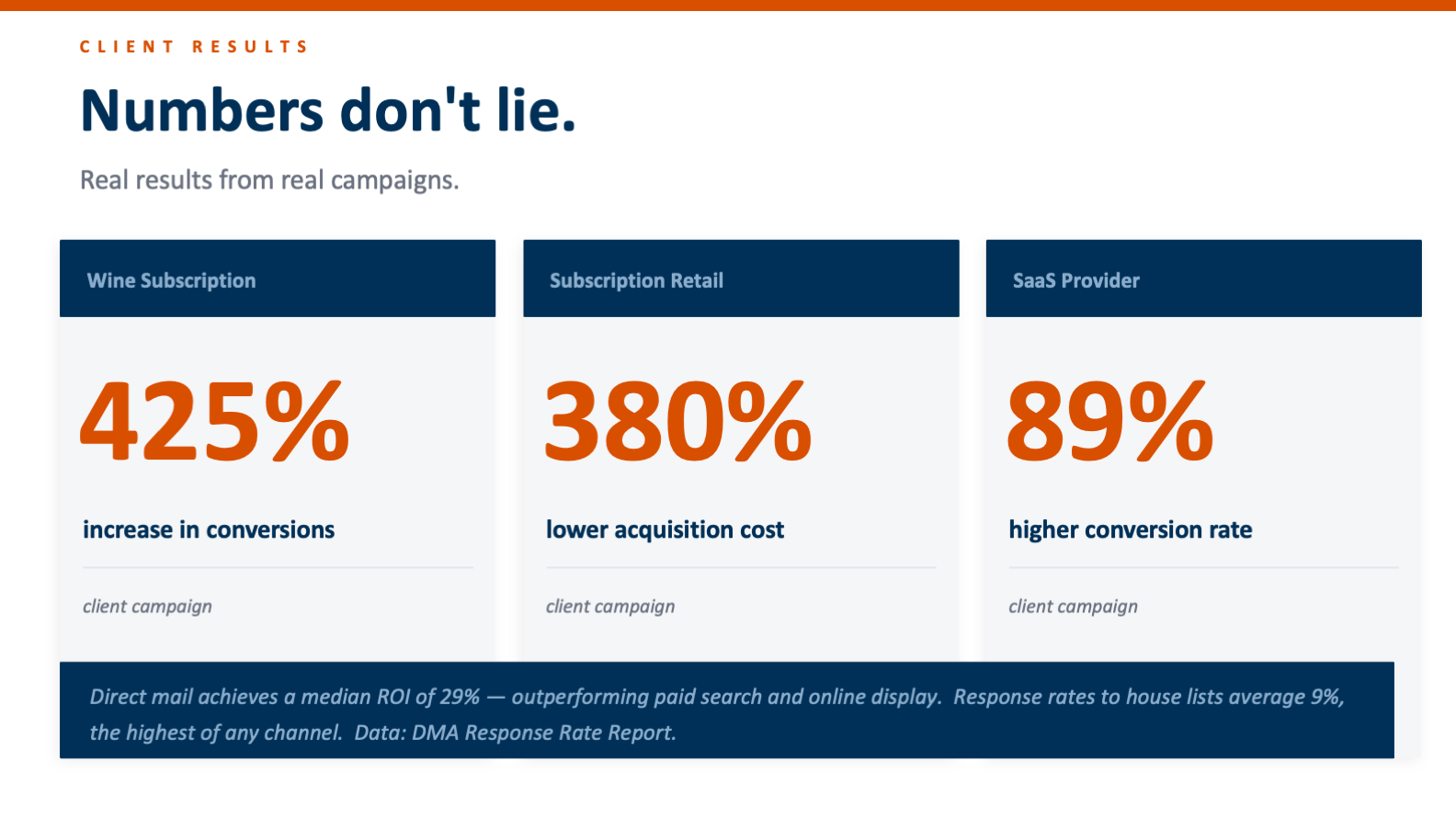

Build the system once, and every pitch after it is assembly, not invention. That is the whole return on a system like this.
From Style Guide to Sales Floor
The work moved in three passes, from setting the standard to proving it in a live pitch.
Set the Standard
system layers
source of truth
Build the Templates
templates
icon set
Prove It With the Pitch
sales deck
off-system slides
- A full system guide: color, typography, icons, and usage rules
- A seven-layout template library covering every pitch moment
- A custom icon library with clear pairing and usage standards
- A do's and don'ts governance layer for on-brand output at speed
- A complete client-facing sales deck built entirely from the system
The person using this system is mid-pitch-prep, not mid-design-review. Every choice, from when-to-use notes on each template to a plain do's and don'ts, was made so the right move is also the fast move, and the brand stays intact even when the clock does not.
What the System Achieves
The system turns deck-building from a recurring brand risk into a repeatable strength. Instead of starting from a blank slide, a rep assembles a pitch from proven layouts and ships something polished, persuasive, and unmistakably on-brand, fast.
Because consistency is built into the system rather than left to each person's discipline, the brand shows up strong in the one place it is most exposed: across the table from a buyer. And the sales deck proves the point, a pitch good enough to win the room, made entirely from parts anyone on the team can reuse.
- On-brand decks from anyone, with no designer in the loop
- Faster pitch prep, since every moment already has a template
- Stronger proof, with results framed to land before they are read
- A brand that holds together at the point of sale
- A reusable foundation every future deck can build on
- Design systems thinking applied to sales enablement
- Brand governance that survives non-designers and deadlines
- Template and icon architecture built for reuse at scale
- Persuasive sales storytelling and data visualization
- The judgment to design both the system and the proof it works